Module 4: Contemporary Colonial Legacies
Module 4: Contemporary Colonial Legacies
Indian Act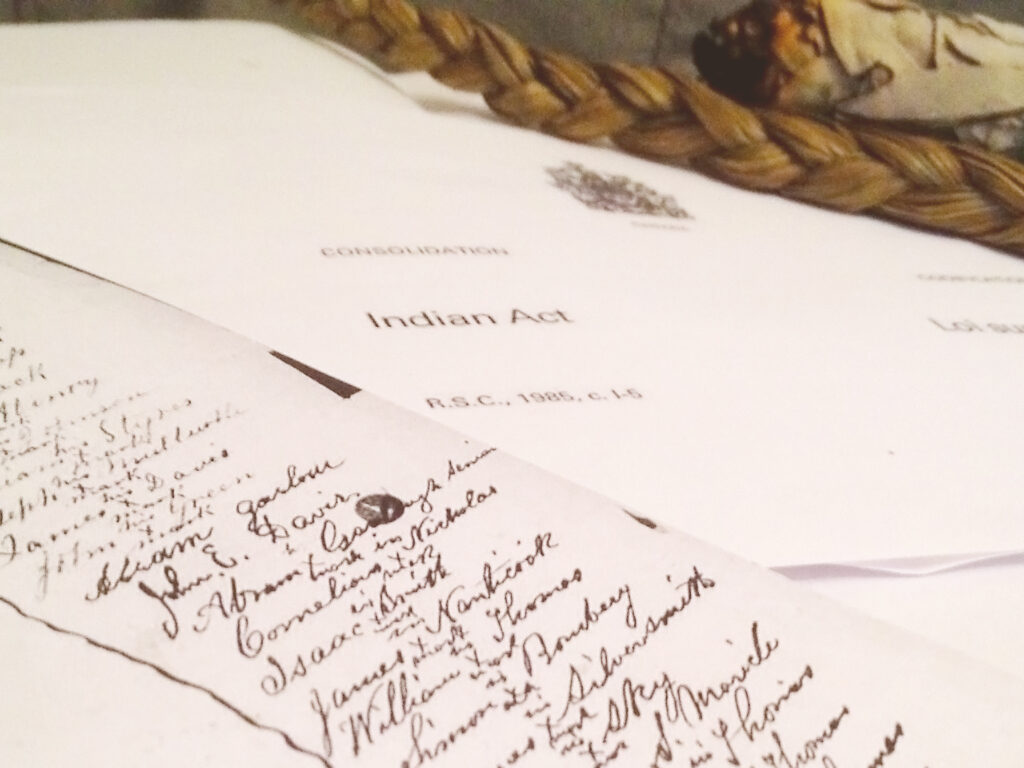
3 Big Ideas
The Devastating Impact of the Potlatch Ban
In 1884, an amendment to the Indian Act banned Potlatch ceremonies. I learned that “the potlatch was one of the most important ceremonies for coastal First Nations in the west, and marked important occasions as well as served a crucial role in distribution of wealth” (Hanson, 2009). The ban, which lasted nearly 75 years, disrupted the transmission of oral traditions, cultural practices, and community cohesion.Exclusion of Inuit and Métis Peoples
The Indian Act did not recognize Inuit and Métis peoples as distinct Indigenous groups, and therefore they were not considered Status Indians. This exclusion denied them access to the rights and services afforded to other First Nations peoples under the Act (Crey & Hanson, 2011).Gender Discrimination in Status Rights
Under the Indian Act, Indigenous women who were widowed or abandoned by their husbands lost their Indian status through a process called enfranchisement (Hanson, 2009). This policy not only stripped them of legal recognition but also severed their ties to community and culture.
2 Insights
Preservation of the Potlatch Ceremony
I would like to learn more about how Coastal First Nations preserved or practiced the Potlatch in secret during the ban. Understanding how these traditions endured despite colonial suppression can offer deeper insight into the resilience and values of First Nations communities.The White Paper and the Red Paper
I am interested in exploring the 1969 White Paper and the Indigenous response through the Red Paper. I want to better understand the Canadian government’s attempt to dismantle the Indian Act without consultation, and how First Nations leaders articulated a vision for self-determination and sovereignty. This knowledge is essential for understanding how to meaningfully support the Truth and Reconciliation Commission’s Calls to Action.
1 Question
What alternatives to the Indian Act have been proposed by Indigenous leaders and communities?
Reading “Beyond the Indian Act: Lessons Learned from Independent Land Management by First Nations” by Ken Coates and Britt Baumann really helped me understand both the limitations of the Indian Act and the possibilities that exist beyond it. The article explains how the Indian Act has historically controlled almost every aspect of First Nations life—from land use to identity—and how it continues to be a major barrier to self-determination and economic development.
One of the most eye-opening parts of the article was learning about the First Nations Land Management (FNLM) regime. This system allows First Nations to opt out of the land-related sections of the Indian Act and instead create their own land codes. That means they can make decisions about their lands without needing federal approval, which under the Indian Act can take months or even years. Under FNLM, the same process can take just a few weeks. This kind of autonomy can make a huge difference for communities trying to build housing, attract investment, or manage their lands in ways that reflect their values.
At the same time, the article also made it clear that not all First Nations support the FNLM approach. Some are concerned that it still operates within a colonial framework and doesn’t go far enough in addressing land restitution or full sovereignty. Others worry about the risk of privatizing reserve lands or the administrative burden it places on communities. These are important critiques that remind me there’s no one-size-fits-all solution. Any alternative to the Indian Act needs to be flexible, well-resourced, and led by Indigenous communities themselves.
Overall, this article helped me see that while the Indian Act is deeply flawed, replacing it isn’t just about tearing it down—it’s about building something better in its place, with Indigenous leadership at the center.
What do you think are the biggest challenges in moving beyond the Indian Act?
References
Coates, K., & Baumann, B. (2023). April 2023. https://macdonaldlaurier.ca/wp-content/uploads/2023/04/20230424_FN_land_management_Coates_Baumann_PAPER_FWeb.pdf
Crey, K., & Hanson, E. (2011). Indian Status. Arts.ubc.ca. https://indigenousfoundations.arts.ubc.ca/indian_status/
FemNorthNet. (2016). Colonialism and its Impacts. Resource Development in Northern Communities: Local Women Matter #3.
Ottawa: Canadian Research Institute for the Advancement of Women.
Hanson, E. (2009). The Indian Act. Indigenous Foundations; University of British Columbia. https://indigenousfoundations.arts.ubc.ca/the_indian_act/
"21 Things You May Not Have Known About the Indian Act" by Bob Joseph
3 Big Ideas
Assets on reserve are not subject to seizure under legal process, making it extremely difficult to borrow money to purchase assets. This prevents Indigenous people living on reserves from using their assets to improve the quality of their lives and that of their community. This provision, along with the fact that reserve land is owned by the Crown, prevented Indigenous people from prospering.
The Indian Act forbade First Nations from speaking their native languages, even on their own land. I was aware that Residential Schools punished children for speaking their language, but I did not know that the Indian Act itself banned Indigenous people from speaking their languages outside of school settings.
The government could expropriate portions of reserves or relocate entire reserves if it was deemed expedient. While teaching a B.C. First Peoples course, I was aware that the Crown could appropriate lands, but I didn’t realize they had the power to move entire communities. First Nations' identity is built from their connection and kinship to the land; this must have had a devastating impact.
2 Insights
The Indian Act was not just a set of policies—it was a tool of control and assimilation. It was designed to limit Indigenous autonomy in every aspect of life: economic, cultural, political, and spiritual. This insight helps me understand why the Act remains such a painful and complex issue today.
The long-term impacts of these policies are still visible today. The inability to build equity through land ownership or access credit has contributed to ongoing economic disparities. The suppression of language and forced relocations have also had lasting effects on cultural continuity and mental health.
1 Question
How can Canada move beyond the Indian Act in a way that truly supports Indigenous self-determination and respects treaty rights?
Canada can move beyond the Indian Act by supporting Indigenous-led governance, treaty-making, and reconciliation agreements that affirm inherent rights and title. A strong example of this is the BC Treaty Process, which offers two key pathways for First Nations: modern treaty negotiations and reconciliation agreements.
These reconciliation agreements are signed between a First Nation, the provincial government, and the federal government. They’re designed to recognize Indigenous rights and title, and to support self-governance and decision-making outside of the Indian Act. What makes these agreements important is that they’re based on mutual recognition and respect. They’re not about giving rights—they’re about recognizing rights that have always existed.
The BC Treaty Commission emphasizes that these processes are voluntary and led by First Nations. Each nation defines itself and chooses how to engage. This approach aligns with the United Nations Declaration on the Rights of Indigenous Peoples (UNDRIP), which affirms the right to self-determination.
Modern treaties negotiated through this process clarify land ownership, governance authority, and resource rights. They replace the colonial framework of the Indian Act with nation-to-nation relationships that are built on partnership and long-term collaboration.
Additionally, the Alliance of BC Modern Treaty Nations, formed by eight First Nations, shows how modern treaties can lead to collaborative governance and shared advocacy for treaty implementation.
To move forward, Canada must:
- Support Indigenous nations in defining their own governance structures
- Ensure negotiations are co-developed and well-resourced
- Uphold treaty rights and implement UNDRIP in practice, not just in policy
This approach offers a clear and respectful path beyond the Indian Act—one that centres Indigenous voices and leadership.
References
- BC Treaty Commission. Aboriginal and Treaty Rights. Retrieved from https://www.bctreaty.ca/negotiations/aboriginal-rights/
- BC Treaty Commission. Negotiations Update. Retrieved from https://bctreaty.ca/negotiations/negotiations-update/
- Government of Canada. Recognition and Reconciliation of Rights Policy for Treaty Negotiations in British Columbia. Retrieved from https://www.rcaanc-cirnac.gc.ca
- Government of British Columbia. Declaration on the Rights of Indigenous Peoples Act. Retrieved from https://www2.gov.bc.ca/gov/content/governments/indigenous-people/new-relationship/united-nations-declaration-on-the-rights-of-indigenous-peoples
- United Nations. United Nations Declaration on the Rights of Indigenous Peoples (UNDRIP). Retrieved from https://www.un.org/development/desa/indigenouspeoples/wp-content/uploads/sites/19/2018/11/UNDRIP_E_web.pdf
Residential School Resource: Sugarcane
Annotation of Sugarcane (2024)
Sugarcane is a 2024 documentary co-directed by Julian Brave NoiseCat and Emily Kassie. It focuses on the legacy of Canada’s residential school system, specifically the St. Joseph’s Mission Residential School in British Columbia. What makes this film especially powerful is that it’s personal—NoiseCat’s own family members attended the school, and his journey to uncover the truth from his father and family is woven throughout the film.
The documentary was inspired by the 2021 discovery of unmarked graves at former Kamloops Residential School site, which brought renewed attention to the trauma these institutions caused. Sugarcane combines survivor stories, historical footage, and investigative reporting to show how the impacts of residential schools are still felt today. It doesn’t just look at the past—it connects it to the present, showing how families and communities are still healing.
What stands out is how respectfully the film gives space for survivors to share their stories. It also holds institutions like the Catholic Church and the Canadian government accountable for their roles in the abuse. Overall, Sugarcane is both heartbreaking and hopeful—it’s about truth, justice, and the strength of Indigenous communities.
The link to the film's website is https://sugarcanefilm.com, but I used Disney+ to screen this for my students.
Summary of the Resource
Sugarcane is a powerful and emotionally charged documentary that investigates the abuses at St. Joseph’s Mission Residential School in British Columbia. Co-directed by Julian Brave NoiseCat—whose own father attended the school—the film blends investigative journalism with personal storytelling. It uncovers the hidden truths of the residential school system, while also exploring the long-term impacts on survivors, their families, and their communities.
- The documentary goes beyond historical facts. It shows how the trauma of residential schools continues to shape lives today, through issues like addiction, suicide, and systemic neglect. At the same time, it highlights the strength and resilience of Indigenous communities, especially through the lens of community healing and cultural revitalization.
- I chose Sugarcane because it connects deeply with my students and with me as an educator. It’s not just a documentary—it’s a story of survival, truth-telling, and resistance. The fact that it’s co-directed by an Indigenous filmmaker adds authenticity and ensures that the narrative is grounded in lived experience. It also bridges the gap between past and present, helping students understand that the legacy of residential schools is not just history—it’s ongoing.
- Additionally, I grew up in Williams Lake, B.C., just outside of the residential school where this occurred. I was not aware of the tragedies happening just up the highway from my home. That personal connection makes this resource even more meaningful to me.
- This resource is meaningful because it centres Indigenous voices and experiences in a way that is both accessible and emotionally impactful. It doesn’t sanitize the truth, but it also doesn’t leave viewers in despair. Instead, it shows the power of community, culture, and storytelling in the healing process. For my students, especially those in BCFP 12, this is a crucial message: that healing is possible, and that truth is a necessary step toward reconciliation.
In my classroom, I use Sugarcane to:
- Expand on the concept of intergenerational trauma and its connection to residential schools.
- Facilitate critical discussions about truth, justice, and the role of education in both harm and healing.
- Encourage students to reflect on the importance of community and cultural identity in the face of systemic oppression.
- Connect the film to the Truth and Reconciliation Commission’s Calls to Action, helping students see how education can be a tool for change when it promotes Indigenous perspectives.
Journal Entry: Reflection on Off to School (NFB)
Watching Off to School really made me pause and think about how education has been portrayed historically in Canada—especially when it comes to Indigenous children. At first glance, the film seems to celebrate the lengths Canada went to in order to bring education to remote areas. But when it shifts to the residential school in Moose Factory, the tone changes. The children are shown in silence, in uniform, with no voice or agency. It’s unsettling.
What really struck me is how the film presents this as a positive, even progressive, solution. But knowing what we know now about residential schools, it’s clear that this was part of a much larger system of cultural erasure. The video was created by the National Film Board, likely for a general Canadian audience, and it reflects the colonial mindset of the time—one that saw assimilation as a good thing.
As a teacher, this reminds me how important it is to help students critically analyze historical media. We can’t just take these portrayals at face value. We need to ask: Who made this? Who is it for? What’s being left out? This film is a powerful example of how media can shape public perception and hide uncomfortable truths behind a narrative of progress.
Journal Entry: Reflection on Residential Schools and Indigenous Identity
After watching this collection of short films and videos, I’m left with a deep sense of how powerful storytelling can be—especially when it comes from Indigenous voices. These films didn’t just teach me about residential schools; they helped me feel the emotional weight of what those experiences meant for individuals, families, and entire communities.
What stood out most was how each film, in its own way, showed the lasting impact of colonialism—not just in the past, but in the present. The stories weren’t just about trauma; they were about survival, resistance, and the strength it takes to reclaim identity and culture. They challenged the idea that residential schools were just a “dark chapter” in history. Instead, they showed how those systems were part of a deliberate effort to erase Indigenous cultures—and how those effects are still being felt today.
As an educator, this reinforces how important it is to bring these stories into the classroom—not just as history, but as part of our ongoing responsibility to truth and reconciliation. These films are a reminder that education can be a tool for healing, but only if we’re willing to confront the truth and center the voices that have been silenced for too long.
Reflecting on MMIWG and Teaching Sensitive Topics
After watching the three powerful videos—Tamara Bernard’s We Are More Than Murdered and Missing, Sarah Robinson’s Indigenous Women and the Story of Canada, and Helen Knott’s Peace River Rising—I’m left with a deep sense of responsibility and reflection. These stories are not just about tragedy; they are about truth, resilience, and the urgent need for change.
Tamara Bernard’s talk really struck me. Her metaphor of wearing a moccasin on one foot and a high heel on the other perfectly captured the tension Indigenous women face navigating two worlds. She reminded me that Indigenous women are not just victims—they are leaders, knowledge keepers, and powerful voices in their communities. It’s so important that we don’t reduce them to statistics or headlines.
Sarah Robinson’s talk connected deeply with my teachings in BC First Peoples 12. She clearly outlines how the Indian Act and colonialism, in their goal to “remove the Indian problem,” deliberately sought to diminish and extinguish the role and power of Indigenous women through legislation and policy. This systemic erasure has had lasting impacts—Indigenous women and girls today are significantly more at risk of domestic violence and other forms of violence. What’s even more troubling is how law enforcement and the legal system often reinforce these colonial, paternalistic narratives, failing to protect Indigenous women and perpetuating cycles of harm. Her talk reinforced the importance of teaching students not just the facts, but the systems and ideologies that continue to shape these realities.
Helen Knott’s Peace River Rising was incredibly moving. Her connection between violence against women and violence against the land was something I hadn’t fully considered before. Her story was raw and poetic, and it reminded me that healing is possible—but it takes courage, community, and a willingness to speak the truth.
As an educator, these stories challenge me to think carefully about how I approach sensitive and unsettling topics in the classroom. I want my students to engage with these issues in a way that is respectful, informed, and compassionate. That means creating a safe space where they can ask questions, feel their emotions, and reflect deeply. It also means centering Indigenous voices and ensuring that we’re not just learning about trauma, but also about strength, culture, and resistance.
I’ve learned that it’s okay to feel uncomfortable—these are uncomfortable truths. But discomfort can be a powerful teacher. My role is to guide students through it with care, context, and support. I want them to leave these lessons not just with knowledge, but with empathy and a sense of responsibility to be part of the change
References
Bernard, T. (2016, July 18). We are more than murdered and missing [Video]. TEDx Talks. YouTube. https://www.youtube.com/watch?v=fylLSRQ5kx8
Robinson, S. (n.d.). Indigenous women and the story of Canada [Video]. The Walrus Talks. YouTube. https://www.youtube.com/watch?v=j-juJWQIERo
Knott, H. (n.d.). Peace River Rising [Video]. CBC Docs. YouTube. https://www.youtube.com/watch?v=-u3p3YvvkcA
CBC Kids News. (2023, May 5). Red Dress Day: Learn more about MMIWG2S+ [Video]. YouTube. https://www.youtube.com/watch?v=7QMG6-5ZobY
Journal Entry: Indigenous Child Welfare, Custom Adoption, and the Role of Education
After exploring these resources, I’m left with a deeper understanding of how colonial systems continue to shape the lives of Indigenous children and families in Canada. The overrepresentation of Indigenous children in foster care isn’t just a legacy of the past—it’s a current and ongoing issue rooted in systemic inequities, underfunding, and a lack of culturally appropriate supports.
Cindy Blackstock’s advocacy really stood out to me. Her message is clear and urgent: the lives of Indigenous children should never be politicized. Jordan’s Principle, and the heartbreaking story behind it, is a reminder of how long it can take to get even the most basic rights recognized for First Nations children. It’s unacceptable that children are still being denied care because of jurisdictional disputes.
One area that was completely new to me was Inuit custom adoption. I had no prior knowledge of this practice before engaging with these materials. Learning about it challenged me to think more critically about how we balance respect for Indigenous cultural practices with the need to ensure child safety in today’s legal and social systems. Custom adoption is clearly a meaningful and longstanding tradition in Inuit communities, but it also raises complex questions in the context of modern child welfare frameworks. It’s a delicate issue that requires thoughtful, culturally informed approaches—not blanket policies.
What really struck me, though, is how little of this was covered in my own teacher education. I recently completed the BEd program at UBC, and while there were some important conversations around Indigenous education, the topics of Indigenous child welfare, custom adoption, and the ongoing impacts of the foster care system were not significantly addressed. That feels like a missed opportunity. If we’re serious about reconciliation and supporting Indigenous students and families, these topics need to be part of the core curriculum—not just optional or peripheral. Preservice teacher training must go beyond surface-level inclusion. It needs to equip future educators with a deep understanding of the systems Indigenous children are navigating—both historically and today. That includes trauma-informed practice, cultural safety, and a willingness to confront uncomfortable truths. Education can be a powerful force for change, but only if we’re willing to do the work.
Reflecting on Modules 3 & 4 – Learning, Unlearning, and Moving Forward
As I reflect on my learning from Modules 3 and 4, I’m struck by how much I’ve had to unlearn. These modules have challenged me to confront the ongoing legacies of colonialism—not just as historical facts, but as living systems that continue to shape the lives of Indigenous peoples today. This learning has been emotional, eye-opening, and deeply necessary.
One of the most impactful artifacts for me was the podcast episode The Indian Act from The Secret Life of Canada. It laid bare how this piece of legislation continues to control and define the lives of First Nations people in ways that are often invisible to non-Indigenous Canadians. Paired with Bob Joseph’s 21 Things You May Not Have Known About the Indian Act, I began to see how colonialism is not just a thing of the past—it’s embedded in our laws, institutions, and even our classrooms.
Another powerful moment came from watching The Pass System trailer and reading Colonialism and Its Impacts by Fem North Net. These resources helped me understand how colonial control was enforced through everyday restrictions—where people could go, who they could see, and how they could live. It made me think about how control and surveillance still show up today in systems like child welfare and education.
The short films in Module 4—especially Savage, Four Faces of the Moon, and Etlinisigu'niet (Bleed Down)—were emotionally intense but incredibly important. They didn’t just tell stories of trauma; they told stories of resistance, survival, and cultural reclamation. These films reminded me that Indigenous peoples are not defined by what was done to them, but by their strength, creativity, and connection to land and community.
One of the most personal learning moments came from exploring Inuit custom adoption. I had no prior knowledge of this practice, and learning about it challenged me to think more critically about how we balance cultural respect with child safety. It also made me reflect on how little of this was covered in my BEd program at UBC. While we touched on Indigenous education, we didn’t go deep into the systems that continue to impact Indigenous children and families—like the foster care system, the Sixties Scoop, or the ongoing effects of the Indian Act. That feels like a gap that needs to be addressed.
As I continue working on my inquiry project, I’m thinking a lot about how to bring this learning into my classroom. How do I help students understand that colonization is not just history—it’s now? How do I teach about truth and justice in a way that doesn’t retraumatize but empowers? I’m realizing that this work isn’t about having all the answers—it’s about being willing to ask hard questions, to listen deeply, and to keep learning alongside my students.
These modules have reminded me that education can either uphold colonial systems or help dismantle them. I want to be part of the latter.
Journal Entry: Understanding and Practicing the Circle Process
Reading What Do We Mean by “Circle?” and Nancy Riestenberg’s Circles in Schools helped me reflect more deeply on a practice I’ve already brought into my classroom—formal circles. These readings affirmed what I’ve seen firsthand: circles create a space where students feel safe, heard, and respected. They’re not just a method for discussion—they’re a way of building community and fostering trust.
In my own classroom, I’ve used formal circles to open up space for student voice, and the feedback has been powerful. Students have shared that circles help them feel more connected to one another and more comfortable expressing themselves. There’s something about sitting in a circle, with no hierarchy, that shifts the dynamic. It’s not about right or wrong answers—it’s about listening, sharing, and being present with one another.
What these readings reminded me, though, is that circles are rooted in Indigenous knowledge systems. They’re not just a classroom strategy—they carry cultural and spiritual significance. That’s why it’s so important to understand Indigenous protocols before leading a sharing circle. It’s about respect, not appropriation. If I’m going to use this practice, I need to do so with humility, care, and a commitment to learning from Indigenous voices and teachings.
This reflection has deepened my appreciation for the circle process and reminded me to continue approaching it with intention and respect.


Comments
Post a Comment